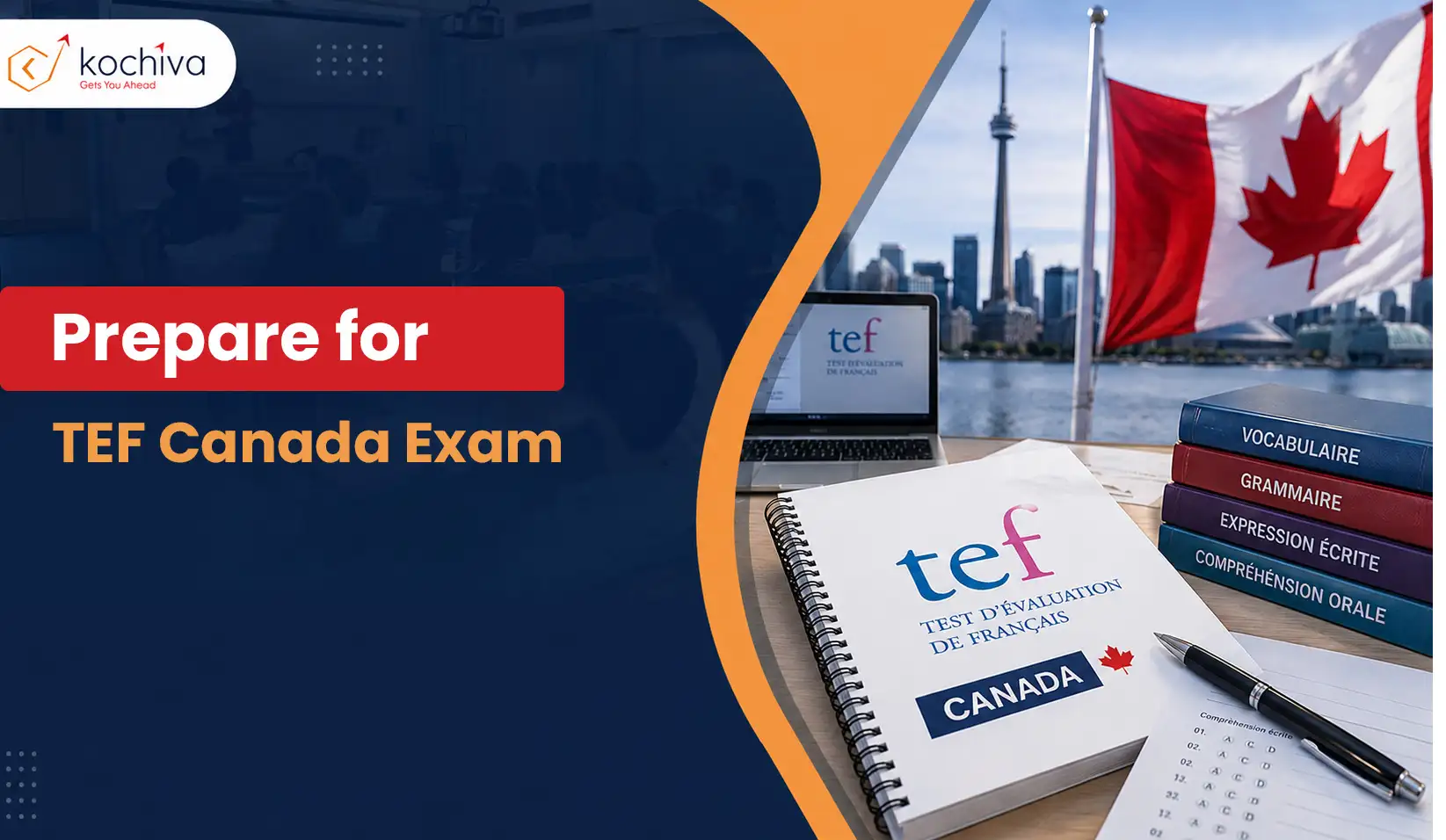
If you want to prepare for TEF Canada exam, having the right study plan and preparation strategy can make a significant difference in your score. Whether your goal is Permanent Residency (PR), Canadian citizenship, or improving your CRS score, preparing effectively is essential.
The TEF Canada exam is an official French language proficiency test accepted by Immigration, Refugees, and Citizenship Canada (IRCC). Furthermore, it evaluates your listening, reading, writing, and speaking skills and converts your results into Canadian Language Benchmark (CLB) levels.
Even if you are a beginner or already have basic French knowledge, this guide will help you understand the exam format, preparation techniques, and best resources to succeed in TEF Canada.
Step-by-step tips to prepare for TEF Canada exam
1. TEF Canada Exam Format and Scoring
Before you prepare for TEF Canada exam, it is important to understand the exam format and scoring system.
Below is a quick overview of the TEF Canada exam format for you to review.
| Sr. no |
Modules |
Format |
Duration |
| 1. |
Listening (Comprehension, orale) |
60 MCQ Questions |
40 minutes |
| 2. |
Reading (Comprehension, ecrite) |
50 MCQ Questions |
60 minutes |
| 3. |
Writing (Expression, orale) |
2 writing tasks |
60 minutes |
| 4. |
Speaking (Expression, ecrite) |
2 face-to-face speaking tasks with an examiner |
15 minutes |
CLB Scoring System
TEF Canada scores are converted into Canadian Language Benchmark (CLB) levels, which are used by IRCC for immigration eligibility.
CLB Conversion (Simplified Overview)
| CLB Level |
Meaning |
| CLB 5 |
Basic working proficiency |
| CLB 7 |
Intermediate proficiency (common PR target) |
| CLB 9 |
Advanced proficiency (high CRS boost) |
You will be tested on listening, reading, writing, and speaking skills separately. The overall CLB score depends on your minimum score across each skill. Therefore, it is very important that your CLB level determines how much Comprehensive Ranking System (CRS) score you are granted through Express Entry. Indeed, an improvement in just one level can improve your opportunity of getting an invitation to apply (ITA).
For getting a more detailed CLB score, visit Kochiva
2. Assess Your Current Level and Set Your Target Score
Before you begin to prepare for TEF Canada exam, decide whether your target is CLB 5, CLB 7, or CLB 9 for your application for immigration. So, it will be clear in your mind how much you need to prepare, and it will also build your confidence.
3. Skill-Based Preparation Strategy
One of the biggest mistakes many candidates make is to concentrate most of their study time on grammar and ignore speaking practice Since every part contributes to your overall performance, therefore, you should balance all four skills with equal priority.
For example:
- Listening + Reading on one day
- Writing + Speaking on another day
Listening Practice
- Do listen to French every day through listening to podcasts and short clips, as well as current events and real conversations, to prepare for TEF Canada exam.
- Don’t focus too much on individual words to make sure you understand everything. So, it’s fine if there are some words you can’t identify. Thus, try to understand the general message of what’s being said instead.
- Finally, your ears learn French phrases, common usage, and flow that real French speakers use, so you begin to think in French.
Reading Practice
- Read French content every day, such as articles, as well as blogs and short news reports.
- Use skimming to understand the main idea quickly.
- Use scanning to locate specific information efficiently.
- Aim to improve reading speed and comprehension for exam timing.
Writing Practice
Follow a clear structure in every writing task:
- Introduction: Present the topic clearly
- Body: Develop 2–3 main ideas in organized paragraphs
- Conclusion: Summarize your opinion or key points
- Focus on clarity, coherence, and logical flow rather than complex vocabulary.
- Practice writing regularly to build speed and accuracy.
Speaking Practice
- First, practice speaking French every day to build fluency and confidence.
- Second, record yourself and review pronunciation, speed, and clarity. Furthermore, pay attention to find out and fix your errors.
- Third, try to think in French during daily activities (for example, forming sentences like “Comment ça va aujourd’hui?” naturally in your mind).
- Avoid translating from your native language; rather, focus on direct French thinking. Therefore, try to train your brain to think in French naturally.
Lastly, useful apps for TEF Canada preparation (speaking practice): HelloTalk, Tandem, iTalki, Duolingo, and Busuu.
Thus, practice all four skills daily in smaller time blocks to ensure steady improvement across all areas.
4. Best Resources to Prepare for TEF Canada Exam
Books: TEF Canada Official Guide, Progressive Grammar of French, Vocabulaire Progressif du Français—Great books to verify grammar and make sure you cover the French grammar rules as well as learn a wide range of vocabulary and French conversation.
Apps: Duolingo, Busuu, Babbel, Speechling, HelloTalk, Tandem—Use these apps for some basic day-to-day French fluency and pronunciation practice so you can improve your spoken French with native speakers.
Websites: RFI Savoirs, TV5MONDE Apprendre le français, Le Monde—Just try to improve listening and reading with these tools; in fact, you can find real French news with actual articles in French.
Courses/Platform: Kochiva (platform for TEF Canada preparation online), PrepMyFuture, GlobalExam—Indeed, these platforms are excellent for organized study, complete TEF sample tests, exam strategies, and guided practice for all sections (listening, reading, writing, and speaking).
5. Take TEF Canada Sample Test
6. Take mock tests regularly.
Mock tests help simulate real exam pressure and improve time management. If you have just started, try to take 1 mock test per week (early stage), and even though you are at the final stage, it is recommended to take 2–3 mock tests per week (final stage).
Practice Under Exam Conditions
- Practice in a quiet place under strict time limits, as this will help you to develop your exam discipline and calm your nerves.
- Moreover, practice answering quickly and correctly because the TEF is timed and a lot of the papers are rushed.
7. Common Mistakes to Avoid
There are many reasons why candidates fail to reach their goal score in the TEF Canada exam. Some of the main reasons include neglecting to practice speaking, which will inevitably affect one’s fluency and confidence in the oral exam. Another common mistake is reaching for the English translation of a sentence instead of producing the utterance directly in French. In addition, many candidates fail to manage time effectively, especially in the reading and listening sections. Furthermore, some neglect to take actual practice tests such as mock exams and instead focus on memorizing answers rather than developing a real understanding of the language.
8. Expert Tips to Score Higher
- First, focus on consistency rather than long study hours
- Next, practice all four skills equally
- Then, track your progress weekly
- Finally, always simulate exam conditions during practice
Also, Try to enroll in a TEF Canada preparation course offered by institutions like Kochiva and PrepMyFuture
1-Month Study Plan (TEF preparation from scratch)
If you are preparing for a TEF Canada test, then this is something you should do!
Follow this 4-week monthly schedule to prepare for all 4 skills: listening, reading, writing, and speaking.
Week 1: Foundation Building
First, familiarize yourself with the format, timing, questions, and types of the TEF Canada. Then, do a simple mock exam to see where you stand. Use everyday life to practice 5-minute simple French listening practices (listening to podcasts, reading news, etc.). Moreover, do simple read-throughs of French articles and revisions of grammar. Practice speaking by reading out loud and recording yourself.
Week 2: Improve Core Skills
Concentrate on practicing every day. Read French documents while timing yourself, listen to dialogues from real-life situations to practice listening skills, and write short, well-organized answers (introduction, body, conclusion). Finally, use speaking applications like HelloTalk or Tandem to practice real speaking; as a result, you will be prepared for TEF exam.
Week 3: Exam Practice Mode
Begin working on complete timed practice tests to become familiar with the real exam situation. Work on speed as well as on accuracy. Work consistently every day on your areas of weakness. Lastly, practice writing under time constraints and speaking without translating.
Week 4: Final Revision & Mock Tests
Complete whole mock exams in the real TEF Canada exam environment. Concentrate on timing, accuracy, and maintaining composure. Moreover, review all key vocabulary, grammar points, and writing templates. Do not introduce new topics, just practice.
Conclusion (Prepare for TEF Canada)
To prepare for TEF Canada, you need to have an effective study plan, practice regularly, and gradually enhance all 4 skills: reading, listening, writing, and speaking. Familiarize yourself with the test structure, take mock tests under time conditions, and strengthen weak skills.
In the end, incorporate French into your daily life, such as listening, reading articles, writing, and speaking as much as you can. If you are dedicated, have the trusted and official resources such as Kochiva, and keep practicing, you will grow in confidence and be able to get the score you want (B2 or C1) in the TEF Canada.
FAQS
1. How long will it take me to prepare for the TEF Canada exam?
Undoubtedly, 2-4 months for the average person, depending on their level of proficiency and goal of CLB.
2. Why Prepare for the TEF Canada Exam?
3. Is TEF Canada hard to pass?
The TEF Canada exam can be challenging for those with no familiarity with real spoken French, as well as those who are not comfortable with timed tests. However, the exam becomes much simpler for those with regular mock test sessions and constant practice.
4. Can I prepare for TEF Canada online?
5. Which is the ideal TEF arrangement program?
Make sure that they offer live lessons and experienced trainers, as well as mock tests for their candidates to take.
6. What TEF Canada sample tests do I look for?
You’ll be able to discover genuine example examination materials within formal books and online-based training programs, as well as TEF preparation facilities.
7. How do I improve my score on the TEF Canada exam?
To improve your score in the TEF Canada exam, you are supposed to practice all four skills regularly and focus on mock tests. Finally, consistency is very important, so practice it every day to build up your speed, accuracy, and confidence.

If you want to prepare for TEF Canada exam, having the right study plan and preparation strategy can make a significant difference in your score. Whether your goal is Permanent Residency (PR), Canadian citizenship, or improving your CRS score, preparing effectively is essential.
The TEF Canada exam is an official French language proficiency test accepted by Immigration, Refugees, and Citizenship Canada (IRCC). Furthermore, it evaluates your listening, reading, writing, and speaking skills and converts your results into Canadian Language Benchmark (CLB) levels.
Even if you are a beginner or already have basic French knowledge, this guide will help you understand the exam format, preparation techniques, and best resources to succeed in TEF Canada.
Step-by-step tips to prepare for TEF Canada exam
1. TEF Canada Exam Format and Scoring
Before you prepare for TEF Canada exam, it is important to understand the exam format and scoring system.
Below is a quick overview of the TEF Canada exam format for you to review.
CLB Scoring System
TEF Canada scores are converted into Canadian Language Benchmark (CLB) levels, which are used by IRCC for immigration eligibility.
CLB Conversion (Simplified Overview)
You will be tested on listening, reading, writing, and speaking skills separately. The overall CLB score depends on your minimum score across each skill. Therefore, it is very important that your CLB level determines how much Comprehensive Ranking System (CRS) score you are granted through Express Entry. Indeed, an improvement in just one level can improve your opportunity of getting an invitation to apply (ITA).
For getting a more detailed CLB score, visit Kochiva
2. Assess Your Current Level and Set Your Target Score
Before you begin to prepare for TEF Canada exam, decide whether your target is CLB 5, CLB 7, or CLB 9 for your application for immigration. So, it will be clear in your mind how much you need to prepare, and it will also build your confidence.
3. Skill-Based Preparation Strategy
One of the biggest mistakes many candidates make is to concentrate most of their study time on grammar and ignore speaking practice Since every part contributes to your overall performance, therefore, you should balance all four skills with equal priority.
For example:
Listening Practice
Reading Practice
Writing Practice
Follow a clear structure in every writing task:
Speaking Practice
Lastly, useful apps for TEF Canada preparation (speaking practice): HelloTalk, Tandem, iTalki, Duolingo, and Busuu.
Thus, practice all four skills daily in smaller time blocks to ensure steady improvement across all areas.
4. Best Resources to Prepare for TEF Canada Exam
Books: TEF Canada Official Guide, Progressive Grammar of French, Vocabulaire Progressif du Français—Great books to verify grammar and make sure you cover the French grammar rules as well as learn a wide range of vocabulary and French conversation.
Apps: Duolingo, Busuu, Babbel, Speechling, HelloTalk, Tandem—Use these apps for some basic day-to-day French fluency and pronunciation practice so you can improve your spoken French with native speakers.
Websites: RFI Savoirs, TV5MONDE Apprendre le français, Le Monde—Just try to improve listening and reading with these tools; in fact, you can find real French news with actual articles in French.
Courses/Platform: Kochiva (platform for TEF Canada preparation online), PrepMyFuture, GlobalExam—Indeed, these platforms are excellent for organized study, complete TEF sample tests, exam strategies, and guided practice for all sections (listening, reading, writing, and speaking).
5. Take TEF Canada Sample Test
6. Take mock tests regularly.
Mock tests help simulate real exam pressure and improve time management. If you have just started, try to take 1 mock test per week (early stage), and even though you are at the final stage, it is recommended to take 2–3 mock tests per week (final stage).
Practice Under Exam Conditions
7. Common Mistakes to Avoid
There are many reasons why candidates fail to reach their goal score in the TEF Canada exam. Some of the main reasons include neglecting to practice speaking, which will inevitably affect one’s fluency and confidence in the oral exam. Another common mistake is reaching for the English translation of a sentence instead of producing the utterance directly in French. In addition, many candidates fail to manage time effectively, especially in the reading and listening sections. Furthermore, some neglect to take actual practice tests such as mock exams and instead focus on memorizing answers rather than developing a real understanding of the language.
8. Expert Tips to Score Higher
Also, Try to enroll in a TEF Canada preparation course offered by institutions like Kochiva and PrepMyFuture
1-Month Study Plan (TEF preparation from scratch)
If you are preparing for a TEF Canada test, then this is something you should do!
Follow this 4-week monthly schedule to prepare for all 4 skills: listening, reading, writing, and speaking.
Week 1: Foundation Building
First, familiarize yourself with the format, timing, questions, and types of the TEF Canada. Then, do a simple mock exam to see where you stand. Use everyday life to practice 5-minute simple French listening practices (listening to podcasts, reading news, etc.). Moreover, do simple read-throughs of French articles and revisions of grammar. Practice speaking by reading out loud and recording yourself.
Week 2: Improve Core Skills
Concentrate on practicing every day. Read French documents while timing yourself, listen to dialogues from real-life situations to practice listening skills, and write short, well-organized answers (introduction, body, conclusion). Finally, use speaking applications like HelloTalk or Tandem to practice real speaking; as a result, you will be prepared for TEF exam.
Week 3: Exam Practice Mode
Begin working on complete timed practice tests to become familiar with the real exam situation. Work on speed as well as on accuracy. Work consistently every day on your areas of weakness. Lastly, practice writing under time constraints and speaking without translating.
Week 4: Final Revision & Mock Tests
Complete whole mock exams in the real TEF Canada exam environment. Concentrate on timing, accuracy, and maintaining composure. Moreover, review all key vocabulary, grammar points, and writing templates. Do not introduce new topics, just practice.
Conclusion (Prepare for TEF Canada)
To prepare for TEF Canada, you need to have an effective study plan, practice regularly, and gradually enhance all 4 skills: reading, listening, writing, and speaking. Familiarize yourself with the test structure, take mock tests under time conditions, and strengthen weak skills.
In the end, incorporate French into your daily life, such as listening, reading articles, writing, and speaking as much as you can. If you are dedicated, have the trusted and official resources such as Kochiva, and keep practicing, you will grow in confidence and be able to get the score you want (B2 or C1) in the TEF Canada.
FAQS
1. How long will it take me to prepare for the TEF Canada exam?
Undoubtedly, 2-4 months for the average person, depending on their level of proficiency and goal of CLB.
2. Why Prepare for the TEF Canada Exam?
3. Is TEF Canada hard to pass?
The TEF Canada exam can be challenging for those with no familiarity with real spoken French, as well as those who are not comfortable with timed tests. However, the exam becomes much simpler for those with regular mock test sessions and constant practice.
4. Can I prepare for TEF Canada online?
5. Which is the ideal TEF arrangement program?
Make sure that they offer live lessons and experienced trainers, as well as mock tests for their candidates to take.
6. What TEF Canada sample tests do I look for?
You’ll be able to discover genuine example examination materials within formal books and online-based training programs, as well as TEF preparation facilities.
7. How do I improve my score on the TEF Canada exam?
To improve your score in the TEF Canada exam, you are supposed to practice all four skills regularly and focus on mock tests. Finally, consistency is very important, so practice it every day to build up your speed, accuracy, and confidence.
Best Online Spanish Classes in India
Best Online German Classes in India
Best Online French Classes in India
Prepare for TEF Canada Exam: Tips & Resources (2026)
French Classes Barrie: Top Platforms List 2026
Top 7 French Classes in Mississauga to Learn French in 2026
Request a Call Back
Related Posts
Prepare for TEF Canada Exam: Tips & Resources (2026)
Read MoreIf you want to prepare for TEF Canada exam, having the right study plan and preparation strategy can make a significant difference in your score. Whether your goal is Permanent Residency (PR), Canadian citizenship, or improving your CRS score, preparing effectively is essential. The TEF Canada exam is an official French language proficiency test accepted by Immigration, Refugees, and Citizenship […]
French Classes Barrie: Top Platforms List 2026
Read MoreLiving in Canada is highly competitive, with thousands of people hustling daily to build their futures. Fortunately, you can unlock incredible new opportunities with French classes Barrie. When you are looking for new career prospects or trying to improve your skills in communication, the importance of a new language can’t be overstated. Indeed, French is one of Canada’s official […]
Top 7 French Classes in Mississauga to Learn French in 2026
Read MoreFrench classes Mississauga are gaining popularity among students, professionals, immigrants, and newcomers looking to gain proficiency in the French language. Regardless of whether you seek career advancement, admission to Canadian colleges and universities, preparation for the TEF Canada test, or simply want to learn French, selecting appropriate French classes in Mississauga can help you efficiently […]
Best Platforms to Learn French: Free & Paid Options Compared
Read MoreIntroduction: Finding the best platforms to learn French is quite confusing, as there are many options available online. There are many platforms offering French language courses with their own learning styles and levels. Figuring out the right one can be an absolute headache. The French Language is one of the most globally popular languages and increasingly relevant in both academic and career sectors. Whether you are […]
5 Best Online German Classes in India for 2026-2027
Read MoreIntroduction: Finding the best online German classes in India in 2026 has become prominent not only because learning a new language has become a trend but because it helps enhance one’s profile and skills to stand out in today’s world. In addition, there is a lot of competition nowadays, and choosing to learn German is a […]
Meet Our Conversion Expert