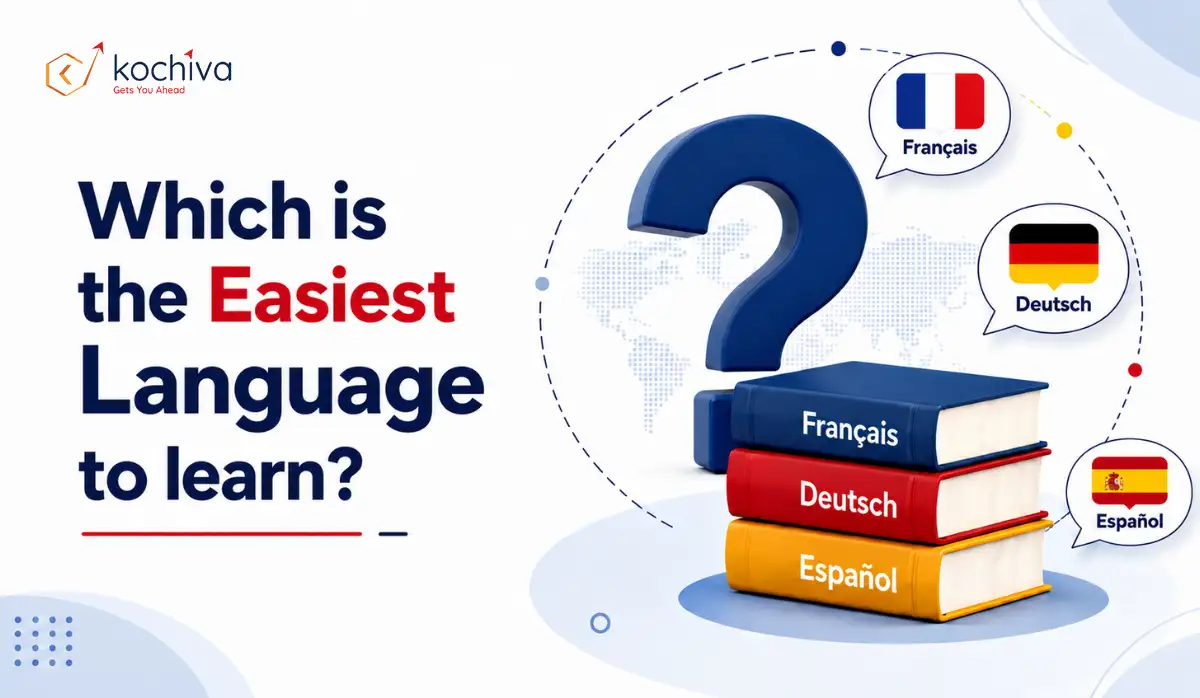
Which is the easiest language to learn? This is a common question among people who want to learn a new language. Therefore, in this blog, we will discuss the top 10 easiest languages to learn in the world.
Learning a new language is always beneficial. It does not really matter if you are a student, working professional, or traveler. Learning an additional language can be worth the effort. In addition, knowing at least one foreign language might open a whole range of new routes for you.
For instance, it can enable you to get a job in any international organization using multiple languages or to attend the very best schools and universities across the world. In this guide, you will find out the simplest languages to learn and identify the one that best suits your goals and interests.
Top 10 Easiest Languages to Learn for English Speakers
-
Spanish
-
Italian
-
Portugese
-
French
-
Dutch
-
Norwegian
-
Swedish
-
Danish
-
Indonesian
-
German
Spanish
To begin with, Spanish is the easiest language to learn for an English speaker. As one of the world’s most widespread languages, with more than 500 million native speakers in over 20 countries, the benefits of speaking Spanish include access to new business opportunities in international careers, higher education, travel, and cultural exchange.
Why it’s easy: Spanish has very straightforward pronunciation rules; most words are spelled as they are pronounced, and it shares many of the same words with English.
Best for: International career opportunities, higher education, travel, and business.
Italian
Similarly, Italian is one of the most popular languages for people to learn, especially for English speakers. It is spoken by around 68 million native speakers, mainly in Italy and parts of Switzerland and other neighboring countries. Moreover, there are many reasons to learn Italian, such as travel, university, history, art, or simply because you want to.
Why it’s easy: Indeed, the pronunciation is regular because the pronunciation of Italian orthography is phonetic. Moreover, Italian also has relatively straightforward grammar. In addition, its vocabulary also shares similarities with English because both languages have many words derived from Latin.
Best for: Travel and education through time, higher learning and intellectual pursuits, visual art, fashion, music, and cultural discovery.
Portuguese
Furthermore, yet another language that is both simple and useful for native English speakers to learn is Portuguese—especially for those who already speak Spanish or any other Romance language. In addition to that, as they begin to discover the culture and the country, many English speakers can benefit from eventually using Portuguese to some extent for their own, or perhaps even their job’s, advancement.
Why it’s easy: Portuguese shares a lot of grammar rules and vocabulary with Spanish (and other Romance languages). Moreover, it also is written in the Latin alphabet, so it is easier for beginners to read and write.
Best for: business aviation, tourism, studying abroad, employability, and cultural interchange.
French
French is one of the most spoken and popular languages to learn. The French language is spoken in many parts of the world, such as Europe, Africa, North America, etc., and can be a great help in learning and employment. Moreover, if you want to learn the French language, then you can turn towards Kochiva. Our platform provides online classes to learn French, German, and Spanish languages from certified trainers in a friendly environment.
Why it’s easy: French shares many similarities with English. With some effort, it can be learned, and its vocabulary and grammar become easier to understand.
Best for: International careers, using higher education and diplomacy, traveling, studying, doing business, or exchanging culture.
Dutch
Dutch is one of the easiest languages to learn for English speakers because they are in the same Germanic language family. It has a native speaker base of 25 million and is mainly spoken in Holland and Belgium. There are many good reasons to learn this language, such as working, studying, or living in a Dutch-speaking country.
Why it’s easy: This language has many things in common with English. For example, pronunciation, vocabulary, grammatical structure, and sentence construction. Moreover, it uses the Latin alphabet, which is very helpful.
Best for: job opportunities, university, moving to the Netherlands or Belgium, commerce, and traveling.
Norwegian
Norwegian (or Norsk) is probably the easiest Scandinavian language to learn for a native English speaker. There are approximately 5 million people speaking Norwegian in all of Norway. It seems to have fewer speakers than some other Scandinavian languages, but it’s worth the effort. You will gain good knowledge of the language of one of the most advanced parts of northern Europe, including the culture.
Why it’s easy: Norwegian is an easy language grammatically and has a similar sentence structure. It also uses the Latin alphabet, and many words are like English words.
Best for: Education and travel
Swedish
Swedish is another easy language for English speakers. It is spoken by more than 10 million people in Sweden, which is generally considered one of the most advanced countries in the world in terms of education and, for instance, good health and safety conditions.
Why it’s easy: The Swedish language has many similarities with English. It has many grammatical similarities and many words in common. The language also uses the Latin alphabet. Its grammar is relatively simple compared to many European languages.
Best for: higher education, career prospects, traveling as well as business, and cultural exchange in Sweden and the rest of the Nordic region.
Danish
Subsequently, of all the Scandinavian languages, Danish is linguistically the closest to English. Moreover, there are about six million speakers in Denmark and two million in Greenland and the Faroes.
In addition to that, facilitating your university, work, and everyday life in Denmark is among the merits of the Danish language.
Why it’s easy: Similarly, Danish shares quite a few words and grammatical aspects with English, as both are part of Germanic languages. Despite its challenging pronunciation, Danish is fairly simple to grasp in terms of grammar.
Best for: education, career, moving to Denmark, traveling & business.
Indonesian (Bahasa Indonesia)
Bahasa Indonesia is the official language of Indonesia and is spoken by over 200 million people as a first or second language. Moreover, it is considered by many to be perhaps the most straightforward of Asian languages for English speakers to learn.
Why it’s easy: One of the easiest things about Bahasa Indonesia is that it has no verb conjugations, no grammatical gender, and no difficult tenses, which are all quite confusing for new learners. Furthermore, it is also simple to pronounce because almost every word is pronounced as it is written.
Best for: The opportunities available to participants include travel, international commerce and cultural interaction, higher education in the region, and employment.
German
Furthermore, having a strong hold on the language English will help you learn the language German easily, as both the languages belong to the same part of the world called the Germanic language family group. In addition to that, approximately almost 100 million native speakers of the German language are all over the world. Moreover, mostly the German speakers are in the countries of Germany, Austria, and Switzerland. Learning German will certainly help you a lot in securing a good job and better education, as well as help in widening your career perspectives and business dealings.
Why it is easy: Certainly, due to the comparability of the words and sentence structures in German to those in English, it is the easiest language in the world for English speakers to learn German. In addition to that, it is also helpful that the Latin alphabet is used in German, as it makes the reading and writing of German much simpler. Moreover, many of the words are like English.
Best for: Higher education, engineering, technology, research, international business, career opportunities, and travel.
What Makes a Language Easy to Learn?
Which language is easy to learn? Certainly, this depends on the various factors. Some of the most key factors are stated below:
1) Similarity to Your Native Language
Firstly, one of the most important factors in determining which is the easiest language to learn is the similarity between the target language and your native language. For example, Spanish can be an easy language to learn for English speakers because there are many similar words and the pronunciation is very straightforward. Likewise for Indian students, Spanish or French can be an easier language to learn than a language with a different script, depending on their native language.
2) Grammar and Sentence Structure
Secondly, languages have their own rules of grammar and sentence structure. Languages with simpler grammar are generally easier to learn than those with more complex grammar.
3) Pronunciation and Writing System
Moreover, another major factor would be pronunciation and the writing system. For example, Dutch uses the Latin alphabet and belongs to the Germanic language family; therefore, it is easier for most English speakers to learn. Likewise, Spanish and Italian have regular pronunciation rules that many find easier to learn over less regular pronunciation requirements.
4) Availability of Learning Resources
Furthermore, without the right learning resources, any language can seem hard to learn. Therefore, if you learn online or offline, with good learning resources, from certified teachers, and with continual practice, then you can learn any additional language easily.
Tips to Learn Any Language Faster
| Tip |
Description |
| Set Clear Goals |
Firstly, define why you want to learn the language to stay motivated. |
| Practice Daily |
Next, spend 20–30 minutes practicing every day for steady progress. |
| Learn Common Vocabulary |
Furthermore, start with frequently used words and everyday phrases. |
| Listen and Speak |
Subsequently, watch videos, listen to podcasts, and speak regularly to improve fluency. |
| Read and Write |
Additionally, read simple content and write short sentences to strengthen your skills. |
| Use Learning Resources |
Similarly, learn through apps, online courses, books, or experienced teachers. |
| Stay Consistent |
Finally, be patient, practice regularly, and learn from your mistakes. |
Final Thoughts (Easiest Language to Learn)
Overall, it is impossible to say which is the easiest language to learn without knowing your native language, learning goals, and personal interests. Additionally, if your native language is English, you may find that Spanish, Italian, Portuguese, and French are the easiest languages to learn because they share many similarities in pronunciation, spelling, vocabulary, and grammar. Moreover, with dedication, the right resources, and regular practice, you can learn any language easily. Also, make sure that the language you choose to learn is relevant to your career, education, and traveling aspirations.
FAQs
-
What is the easiest language to learn?
Certainly, as mentioned previously, this truly depends on your learning goals and native language. In addition, there is no perfect answer to this question. However, Spanish and French are the easy ones for English speakers.
-
Which language is easy to learn for beginners?
If you are asking which language is the easiest to learn, then Spanish is at the top of the list, being easy to pronounce every word. However, again, it depends on various factors. Additionally, other good options for beginners are French, Italian, Dutch, and Portuguese.
-
Which is the easiest language in the world?
Certainly, Spanish is often regarded as one of the easiest languages in the world to learn for English speakers because of its simple pronunciation, consistent spelling, and wide availability of learning resources. Moreover, it is also spoken by millions of people worldwide.
Which is the easiest language to learn? This is a common question among people who want to learn a new language. Therefore, in this blog, we will discuss the top 10 easiest languages to learn in the world.
Learning a new language is always beneficial. It does not really matter if you are a student, working professional, or traveler. Learning an additional language can be worth the effort. In addition, knowing at least one foreign language might open a whole range of new routes for you.
For instance, it can enable you to get a job in any international organization using multiple languages or to attend the very best schools and universities across the world. In this guide, you will find out the simplest languages to learn and identify the one that best suits your goals and interests.
Top 10 Easiest Languages to Learn for English Speakers
Spanish
Italian
Portugese
French
Dutch
Norwegian
Swedish
Danish
Indonesian
German
Spanish
To begin with, Spanish is the easiest language to learn for an English speaker. As one of the world’s most widespread languages, with more than 500 million native speakers in over 20 countries, the benefits of speaking Spanish include access to new business opportunities in international careers, higher education, travel, and cultural exchange.
Why it’s easy: Spanish has very straightforward pronunciation rules; most words are spelled as they are pronounced, and it shares many of the same words with English.
Best for: International career opportunities, higher education, travel, and business.
Italian
Similarly, Italian is one of the most popular languages for people to learn, especially for English speakers. It is spoken by around 68 million native speakers, mainly in Italy and parts of Switzerland and other neighboring countries. Moreover, there are many reasons to learn Italian, such as travel, university, history, art, or simply because you want to.
Why it’s easy: Indeed, the pronunciation is regular because the pronunciation of Italian orthography is phonetic. Moreover, Italian also has relatively straightforward grammar. In addition, its vocabulary also shares similarities with English because both languages have many words derived from Latin.
Best for: Travel and education through time, higher learning and intellectual pursuits, visual art, fashion, music, and cultural discovery.
Portuguese
Furthermore, yet another language that is both simple and useful for native English speakers to learn is Portuguese—especially for those who already speak Spanish or any other Romance language. In addition to that, as they begin to discover the culture and the country, many English speakers can benefit from eventually using Portuguese to some extent for their own, or perhaps even their job’s, advancement.
Why it’s easy: Portuguese shares a lot of grammar rules and vocabulary with Spanish (and other Romance languages). Moreover, it also is written in the Latin alphabet, so it is easier for beginners to read and write.
Best for: business aviation, tourism, studying abroad, employability, and cultural interchange.
French
French is one of the most spoken and popular languages to learn. The French language is spoken in many parts of the world, such as Europe, Africa, North America, etc., and can be a great help in learning and employment. Moreover, if you want to learn the French language, then you can turn towards Kochiva. Our platform provides online classes to learn French, German, and Spanish languages from certified trainers in a friendly environment.
Why it’s easy: French shares many similarities with English. With some effort, it can be learned, and its vocabulary and grammar become easier to understand.
Best for: International careers, using higher education and diplomacy, traveling, studying, doing business, or exchanging culture.
Dutch
Dutch is one of the easiest languages to learn for English speakers because they are in the same Germanic language family. It has a native speaker base of 25 million and is mainly spoken in Holland and Belgium. There are many good reasons to learn this language, such as working, studying, or living in a Dutch-speaking country.
Why it’s easy: This language has many things in common with English. For example, pronunciation, vocabulary, grammatical structure, and sentence construction. Moreover, it uses the Latin alphabet, which is very helpful.
Best for: job opportunities, university, moving to the Netherlands or Belgium, commerce, and traveling.
Norwegian
Norwegian (or Norsk) is probably the easiest Scandinavian language to learn for a native English speaker. There are approximately 5 million people speaking Norwegian in all of Norway. It seems to have fewer speakers than some other Scandinavian languages, but it’s worth the effort. You will gain good knowledge of the language of one of the most advanced parts of northern Europe, including the culture.
Why it’s easy: Norwegian is an easy language grammatically and has a similar sentence structure. It also uses the Latin alphabet, and many words are like English words.
Best for: Education and travel
Swedish
Swedish is another easy language for English speakers. It is spoken by more than 10 million people in Sweden, which is generally considered one of the most advanced countries in the world in terms of education and, for instance, good health and safety conditions.
Why it’s easy: The Swedish language has many similarities with English. It has many grammatical similarities and many words in common. The language also uses the Latin alphabet. Its grammar is relatively simple compared to many European languages.
Best for: higher education, career prospects, traveling as well as business, and cultural exchange in Sweden and the rest of the Nordic region.
Danish
Subsequently, of all the Scandinavian languages, Danish is linguistically the closest to English. Moreover, there are about six million speakers in Denmark and two million in Greenland and the Faroes.
In addition to that, facilitating your university, work, and everyday life in Denmark is among the merits of the Danish language.
Why it’s easy: Similarly, Danish shares quite a few words and grammatical aspects with English, as both are part of Germanic languages. Despite its challenging pronunciation, Danish is fairly simple to grasp in terms of grammar.
Best for: education, career, moving to Denmark, traveling & business.
Indonesian (Bahasa Indonesia)
Bahasa Indonesia is the official language of Indonesia and is spoken by over 200 million people as a first or second language. Moreover, it is considered by many to be perhaps the most straightforward of Asian languages for English speakers to learn.
Why it’s easy: One of the easiest things about Bahasa Indonesia is that it has no verb conjugations, no grammatical gender, and no difficult tenses, which are all quite confusing for new learners. Furthermore, it is also simple to pronounce because almost every word is pronounced as it is written.
Best for: The opportunities available to participants include travel, international commerce and cultural interaction, higher education in the region, and employment.
German
Furthermore, having a strong hold on the language English will help you learn the language German easily, as both the languages belong to the same part of the world called the Germanic language family group. In addition to that, approximately almost 100 million native speakers of the German language are all over the world. Moreover, mostly the German speakers are in the countries of Germany, Austria, and Switzerland. Learning German will certainly help you a lot in securing a good job and better education, as well as help in widening your career perspectives and business dealings.
Why it is easy: Certainly, due to the comparability of the words and sentence structures in German to those in English, it is the easiest language in the world for English speakers to learn German. In addition to that, it is also helpful that the Latin alphabet is used in German, as it makes the reading and writing of German much simpler. Moreover, many of the words are like English.
Best for: Higher education, engineering, technology, research, international business, career opportunities, and travel.
What Makes a Language Easy to Learn?
Which language is easy to learn? Certainly, this depends on the various factors. Some of the most key factors are stated below:
1) Similarity to Your Native Language
Firstly, one of the most important factors in determining which is the easiest language to learn is the similarity between the target language and your native language. For example, Spanish can be an easy language to learn for English speakers because there are many similar words and the pronunciation is very straightforward. Likewise for Indian students, Spanish or French can be an easier language to learn than a language with a different script, depending on their native language.
2) Grammar and Sentence Structure
Secondly, languages have their own rules of grammar and sentence structure. Languages with simpler grammar are generally easier to learn than those with more complex grammar.
3) Pronunciation and Writing System
Moreover, another major factor would be pronunciation and the writing system. For example, Dutch uses the Latin alphabet and belongs to the Germanic language family; therefore, it is easier for most English speakers to learn. Likewise, Spanish and Italian have regular pronunciation rules that many find easier to learn over less regular pronunciation requirements.
4) Availability of Learning Resources
Furthermore, without the right learning resources, any language can seem hard to learn. Therefore, if you learn online or offline, with good learning resources, from certified teachers, and with continual practice, then you can learn any additional language easily.
Tips to Learn Any Language Faster
Final Thoughts (Easiest Language to Learn)
Overall, it is impossible to say which is the easiest language to learn without knowing your native language, learning goals, and personal interests. Additionally, if your native language is English, you may find that Spanish, Italian, Portuguese, and French are the easiest languages to learn because they share many similarities in pronunciation, spelling, vocabulary, and grammar. Moreover, with dedication, the right resources, and regular practice, you can learn any language easily. Also, make sure that the language you choose to learn is relevant to your career, education, and traveling aspirations.
FAQs
What is the easiest language to learn?
Certainly, as mentioned previously, this truly depends on your learning goals and native language. In addition, there is no perfect answer to this question. However, Spanish and French are the easy ones for English speakers.
Which language is easy to learn for beginners?
If you are asking which language is the easiest to learn, then Spanish is at the top of the list, being easy to pronounce every word. However, again, it depends on various factors. Additionally, other good options for beginners are French, Italian, Dutch, and Portuguese.
Which is the easiest language in the world?
Certainly, Spanish is often regarded as one of the easiest languages in the world to learn for English speakers because of its simple pronunciation, consistent spelling, and wide availability of learning resources. Moreover, it is also spoken by millions of people worldwide.
Best Online Spanish Classes in India
Best Online German Classes in India
Best Online French Classes in India (2026)
Top 5 French language course in Dehradun 2026
Foreign Language Study Abroad: Affordable Health Insurance Plans
TCF French Classes: Preparation, Exam Format and More
Request a Call Back
Related Posts
Top 5 French language course in Dehradun 2026
Read MoreThe best French language course in Dehradun follow CEFR-curriculam and offer classes from beginner to advanced French level as well as exam-focused preparation. There are many options out there, from e-learning to face-to-face training. You can choose a course that suits your schedule, objectives, and preferences. Having French skills can help you for taking admission in bilingual universities, […]
Foreign Language Study Abroad: Affordable Health Insurance Plans
Read MoreStudying a foreign language abroad is one of the most rewarding academic decisions a student can make. Immersion in a language – hearing it spoken naturally, practising it daily with native speakers, and experiencing the culture that surrounds it – accelerates learning in ways that classroom instruction at home simply cannot replicate. But the practical […]
TCF French Classes: Preparation, Exam Format and More
Read MoreTCF French classes are French language classes specifically designed to prepare students for the TCF (Test de connaissance du français), a standardized French proficiency test. Choosing the right TCF French classes can help you prepare effectively and work towards your target score. In this guide we will cover everything you need to know to understand the […]
Unskilled Jobs in Germany for Indians: Jobs, Salary & Visa Guide
Read MoreUnskilled jobs in Germany are suitable for people who may not have a university degree or specialized professional qualification. Germany not only needs high-tech professionals but also needs workers for unskilled jobs, as it is facing a real shortage. In addition, unskilled jobs include warehouse work, cleaning, delivery, factory production lines, farming, and basic hospitality […]
CLB vs NCLC Canada: Understanding the Difference for Canadian PR
Read MoreImagine you are a software engineer from India, and you want to apply for Canadian PR through the Express Entry system. You thought of taking the TEF Canada exam to improve your CRS score. And while researching, you come across terms like “CLB,” “NCLC,” and “CLB vs NCLC.” You may start wondering, “Is CLB 7 the same as NCLC 7?” […]
Meet Our Conversion Expert