The top emerging career skills in 2026 reflect a major shift in how organisations evaluate talent. Employers are no longer focused solely on technical credentials. Instead, they are prioritising professionals who combine digital fluency, analytical thinking, and strong interpersonal abilities in their framed credentials.
Workplaces across industries are changing rapidly as automation, artificial intelligence, and global collaboration reshape how teams operate. According to recent workforce research, employers increasingly value adaptable skills that allow employees to learn quickly and solve unfamiliar challenges.
According to recent workforce research, employers increasingly value adaptable skills that allow employees to learn quickly and solve unfamiliar challenges. Offering internships for high school students helps young learners build these adaptable skills early.
The most successful professionals in 2026 will be those who combine modern technical capabilities with strategic thinking and communication skills.
This guide highlights ten emerging career skills that employers are actively seeking and explains how these skills create value in real workplace situations.
Emerging Career Skills Employers Value in 2026
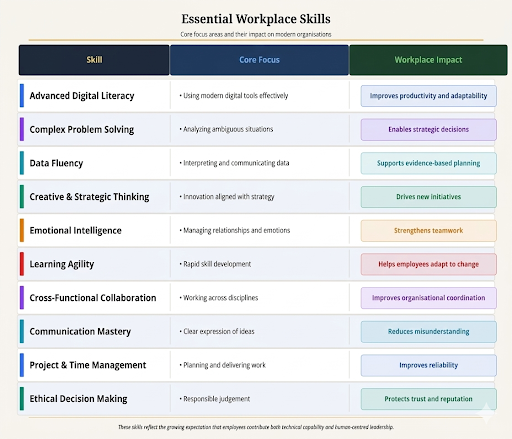
These skills reflect the growing expectation that employees contribute both technical capability and human-centred leadership.
1. Advanced Digital Literacy
What it means
Advanced digital literacy refers to the ability to confidently use modern digital tools, platforms, and systems that support collaboration and productivity.
Why employers value it
Workplaces increasingly depend on cloud platforms, collaboration software, and digital project management tools. Employees who adapt quickly to new technologies improve efficiency and reduce onboarding time. Choosing the right team collaboration tools can help businesses streamline workflows, improve knowledge sharing, and keep employees connected across departments.
Research shows that digital competence is becoming a foundational requirement across industries. As AI assistants increasingly answer queries that once started on a search engine, knowing how a brand actually surfaces in those AI responses has quietly become part of that digital competence, and an Arobis AI Visibility Checker offers a quick read on where a name is being cited.
How it appears in the workplace
Employees demonstrate digital literacy when they:
- Manage cloud-based documentation
- Coordinate work using digital collaboration tools
- Integrate software systems into workflows
- Troubleshoot digital platforms independently
2. Complex Problem Solving
What it means
Complex problem solving is the ability to evaluate uncertain situations, identify critical variables, and develop solutions that consider multiple outcomes.
Why employers value it
Modern organisations face challenges that do not follow predictable patterns. Professionals who can analyse ambiguity and generate actionable solutions help organisations stay competitive.
The World Economic Forum consistently ranks complex problem solving among the most important future workplace skills.
How it appears in the workplace
Examples include:
- Identifying operational inefficiencies
- Resolving customer experience challenges
- Designing strategic responses to market changes
3. Data Fluency
What it means
Data fluency is the ability to interpret data, question assumptions, and communicate insights clearly.
Why employers value it
Data driven decision making has become central to organisational strategy. As this capability grows across organisations, internal roles also need to evolve to support it. This shift also highlights upskilling HR teams as organisations focus on building stronger data skills across departments. Employees who translate data into understandable insights help teams make better decisions.
Businesses increasingly rely on analytics to guide operations, marketing, and product development.
How it appears in the workplace
Professionals may:
- Analyse performance dashboards
- Identify patterns in customer behaviour
- Present insights that inform strategic planning
4. Creative and Strategic Thinking
What it means
Creative and strategic thinking involves generating innovative ideas while aligning them with long term organisational goals.
Why employers value it
Innovation drives growth. Employees who combine imagination with practical planning help organisations adapt to new opportunities and challenges.
How it appears in the workplace
Creative strategic thinking appears when employees:
- Reframe stagnant projects with new approaches
- Develop innovative products or services
- Identify opportunities in emerging markets
5. Emotional Intelligence
What it means
Emotional intelligence refers to the ability to understand and manage one’s own emotions while responding effectively to the emotions of others.
Why employers value it
High performing teams depend on trust and communication. Employees with emotional intelligence strengthen collaboration and reduce conflict.
Studies consistently show that emotional intelligence improves leadership effectiveness and team performance.
How it appears in the workplace
Examples include:
- Managing difficult conversations with empathy
- Supporting colleagues during high-pressure projects
- Building trust with clients and partners
6. Learning Agility
What it means
Learning agility is the ability to quickly acquire new skills and adapt to unfamiliar situations.
Why employers value it
Technology and workflows evolve rapidly. Employees who learn quickly reduce training time and help organisations adopt new systems faster.
How it appears in the workplace
Professionals demonstrate learning agility when they:
- Master new tools quickly
- Transition between different project roles
- Apply lessons from one situation to another
7. Cross-Functional Collaboration
What it means
Cross-functional collaboration involves working effectively with teams from different disciplines and organisational units.
Why employers value it
Many modern problems require expertise from multiple
communication gaps, improve coordination, and achieve better project outcomes.
How it appears in the workplace
Examples include:
- Product teams collaborating with marketing and engineering
- Operations teams working with finance and analytics
- Cross-department initiatives that require shared decision making
8. Communication Mastery
What it means
Communication mastery is the ability to express ideas clearly in written, verbal, and visual forms.
Why employers value it
Clear communication reduces misunderstandings and accelerates decision making.
Employees who translate complex ideas into clear messages improve collaboration and productivity. When you translate your content for diverse teams, you reduce misunderstandings and ensure every stakeholder stays aligned on project goals.
How it appears in the workplace
Communication mastery appears through:
- Presentations and reports
- Client discussions and negotiations
- Internal team alignment
9. Project and Time Management
What it means
Project and time management involve planning tasks, allocating resources, and delivering results on schedule.
Why employers value it
Reliable execution improves organisational stability. Professionals looking to strengthen these capabilities often pursue the PMP certification, using structured project management training to build practical project management skills and demonstrate their expertise to employers. Employees who manage time and projects effectively help teams meet goals consistently.
How it appears in the workplace
Professionals demonstrate this skill by:
- Creating clear project timelines
- Tracking progress against milestones
- Communicating updates to stakeholders
10. Ethical Decision Making
What it means
Ethical decision making refers to evaluating choices through fairness, transparency, and accountability.
Why employers value it
Organisational trust depends on responsible behaviour. Ethical employees protect company reputation and maintain strong relationships with stakeholders.
How it appears in the workplace
Examples include:
- Handling sensitive information responsibly
- Raising concerns about harmful practices
- Considering social and organisational impact when making decisions
Final Thoughts
The most valuable professionals in 2026 will combine technical competence with human-centred capabilities.
Employers are looking for individuals who can:
- Analyse complex challenges
- Communicate clearly
- Adapt quickly to new tools and environments
- Collaborate effectively across teams
By developing these emerging career skills, professionals position themselves for stronger opportunities and long term career resilience in a rapidly changing workplace.
FAQ: Emerging Career Skills in 2026
What skills are most in demand in 2026?
Employers increasingly prioritise digital literacy, complex problem solving, data fluency, and communication skills alongside emotional intelligence and adaptability.
Why are soft skills becoming more important?
Automation is changing many technical roles. Human skills such as collaboration, creativity, and communication remain difficult to automate and therefore more valuable.
How can professionals develop emerging career skills?
Professionals can build these skills through structured learning, practical projects, mentorship, and continuous professional development.
About the Author: Tasmir Aziz holds an MSc in South Asian Studies from the University of Oxford. He is a researcher and educator who has mentored over 100 students worldwide in research, college applications, and academic project development.

The top emerging career skills in 2026 reflect a major shift in how organisations evaluate talent. Employers are no longer focused solely on technical credentials. Instead, they are prioritising professionals who combine digital fluency, analytical thinking, and strong interpersonal abilities in their framed credentials.
Workplaces across industries are changing rapidly as automation, artificial intelligence, and global collaboration reshape how teams operate. According to recent workforce research, employers increasingly value adaptable skills that allow employees to learn quickly and solve unfamiliar challenges.
According to recent workforce research, employers increasingly value adaptable skills that allow employees to learn quickly and solve unfamiliar challenges. Offering internships for high school students helps young learners build these adaptable skills early.
The most successful professionals in 2026 will be those who combine modern technical capabilities with strategic thinking and communication skills.
This guide highlights ten emerging career skills that employers are actively seeking and explains how these skills create value in real workplace situations.
Emerging Career Skills Employers Value in 2026
These skills reflect the growing expectation that employees contribute both technical capability and human-centred leadership.
1. Advanced Digital Literacy
What it means
Advanced digital literacy refers to the ability to confidently use modern digital tools, platforms, and systems that support collaboration and productivity.
Why employers value it
Workplaces increasingly depend on cloud platforms, collaboration software, and digital project management tools. Employees who adapt quickly to new technologies improve efficiency and reduce onboarding time. Choosing the right team collaboration tools can help businesses streamline workflows, improve knowledge sharing, and keep employees connected across departments.
Research shows that digital competence is becoming a foundational requirement across industries. As AI assistants increasingly answer queries that once started on a search engine, knowing how a brand actually surfaces in those AI responses has quietly become part of that digital competence, and an Arobis AI Visibility Checker offers a quick read on where a name is being cited.
How it appears in the workplace
Employees demonstrate digital literacy when they:
2. Complex Problem Solving
What it means
Complex problem solving is the ability to evaluate uncertain situations, identify critical variables, and develop solutions that consider multiple outcomes.
Why employers value it
Modern organisations face challenges that do not follow predictable patterns. Professionals who can analyse ambiguity and generate actionable solutions help organisations stay competitive.
The World Economic Forum consistently ranks complex problem solving among the most important future workplace skills.
How it appears in the workplace
Examples include:
3. Data Fluency
What it means
Data fluency is the ability to interpret data, question assumptions, and communicate insights clearly.
Why employers value it
Data driven decision making has become central to organisational strategy. As this capability grows across organisations, internal roles also need to evolve to support it. This shift also highlights upskilling HR teams as organisations focus on building stronger data skills across departments. Employees who translate data into understandable insights help teams make better decisions.
Businesses increasingly rely on analytics to guide operations, marketing, and product development.
How it appears in the workplace
Professionals may:
4. Creative and Strategic Thinking
What it means
Creative and strategic thinking involves generating innovative ideas while aligning them with long term organisational goals.
Why employers value it
Innovation drives growth. Employees who combine imagination with practical planning help organisations adapt to new opportunities and challenges.
How it appears in the workplace
Creative strategic thinking appears when employees:
5. Emotional Intelligence
What it means
Emotional intelligence refers to the ability to understand and manage one’s own emotions while responding effectively to the emotions of others.
Why employers value it
High performing teams depend on trust and communication. Employees with emotional intelligence strengthen collaboration and reduce conflict.
Studies consistently show that emotional intelligence improves leadership effectiveness and team performance.
How it appears in the workplace
Examples include:
6. Learning Agility
What it means
Learning agility is the ability to quickly acquire new skills and adapt to unfamiliar situations.
Why employers value it
Technology and workflows evolve rapidly. Employees who learn quickly reduce training time and help organisations adopt new systems faster.
How it appears in the workplace
Professionals demonstrate learning agility when they:
7. Cross-Functional Collaboration
What it means
Cross-functional collaboration involves working effectively with teams from different disciplines and organisational units.
Why employers value it
How it appears in the workplace
Examples include:
8. Communication Mastery
What it means
Communication mastery is the ability to express ideas clearly in written, verbal, and visual forms.
Why employers value it
Clear communication reduces misunderstandings and accelerates decision making.
Employees who translate complex ideas into clear messages improve collaboration and productivity. When you translate your content for diverse teams, you reduce misunderstandings and ensure every stakeholder stays aligned on project goals.
How it appears in the workplace
Communication mastery appears through:
9. Project and Time Management
What it means
Project and time management involve planning tasks, allocating resources, and delivering results on schedule.
Why employers value it
Reliable execution improves organisational stability. Professionals looking to strengthen these capabilities often pursue the PMP certification, using structured project management training to build practical project management skills and demonstrate their expertise to employers. Employees who manage time and projects effectively help teams meet goals consistently.
How it appears in the workplace
Professionals demonstrate this skill by:
10. Ethical Decision Making
What it means
Ethical decision making refers to evaluating choices through fairness, transparency, and accountability.
Why employers value it
Organisational trust depends on responsible behaviour. Ethical employees protect company reputation and maintain strong relationships with stakeholders.
How it appears in the workplace
Examples include:
Final Thoughts
The most valuable professionals in 2026 will combine technical competence with human-centred capabilities.
Employers are looking for individuals who can:
By developing these emerging career skills, professionals position themselves for stronger opportunities and long term career resilience in a rapidly changing workplace.
FAQ: Emerging Career Skills in 2026
What skills are most in demand in 2026?
Employers increasingly prioritise digital literacy, complex problem solving, data fluency, and communication skills alongside emotional intelligence and adaptability.
Why are soft skills becoming more important?
Automation is changing many technical roles. Human skills such as collaboration, creativity, and communication remain difficult to automate and therefore more valuable.
How can professionals develop emerging career skills?
Professionals can build these skills through structured learning, practical projects, mentorship, and continuous professional development.
About the Author: Tasmir Aziz holds an MSc in South Asian Studies from the University of Oxford. He is a researcher and educator who has mentored over 100 students worldwide in research, college applications, and academic project development.
Best Online Spanish Classes in India
Best Online German Classes in India
Best Online French Classes in India (2026)
Best 5 TEF Canada Classes in Edmonton (2026 Complete Guide)
Top 7 TEF French classes in Calgary: Guide 2026
Best 6 TEF French Classes in Winnipeg (2026 Guide)
Request a Call Back
Related Posts
Best 5 TEF Canada Classes in Edmonton (2026 Complete Guide)
Read MoreTEF Canada classes in Edmonton are one of the fastest ways to boost your French score and add valuable CRS points to your Express Entry Profile. With one of Alberta’s most active Francophone communities and a steady stream of newcomers, Edmonton now offers more choices than ever in-person language schools, community organizations, private tutors, […]
Top 7 TEF French classes in Calgary: Guide 2026
Read MoreSearching for TEF French classes in Calgary? The right TEF preparation course can help you improve your French language skills, prepare for the exam’s listening, speaking, reading, and writing sections, and get a good TEF score. Whether you’re looking to enhance your Express Entry profile or to satisfy French-language requirements for Canadian immigration. Here is […]
Best 6 TEF French Classes in Winnipeg (2026 Guide)
Read MoreLooking for the TEF French classes in Winnipeg? Whether you are aiming to boost your Express Entry score, qualify for a Manitoba immigration pathway, or prove your French citizenship, the right French preparation can help you reach your goals. The TEF exam tests your listening, reading, speaking, and writing skills. By preparing carefully, you can […]
Best TEF Preparation Course Chandigarh for Canada Immigration
Read MoreA TEF preparation course in Chandigarh can assist candidates in enhancing their French skills and getting ready for the TEF Canada exam. The Test d’évaluation de français (TEF) is a test of French language proficiency for Canadian immigration and other applications. Structure lessons, practise with mock tests, and get help from experts to become […]
6 Best TEF Preparation course in Canada 2026 Guide
Read MoreEnrolling in a TEF preparation course in Canada can help candidates become familiar with the TEF exam format and strengthen their French language skills. The TEF Canada is a crucial French language proficiency test for anyone applying through a Canadian immigration pathway. Many institutions and online training providers offer French language training for exam […]
Meet Our Conversion Expert