
If you are wondering how to become a data analyst, you must possess certain data analysis abilities along with finishing a few tasks. In this article on how to become a data analyst, we will provide you with an in-depth overview of what you must do to become data analyst, the requirements for a data analyst, and get you one step closer to realizing your dream of being a data analyst.
A data analyst collects and analyzes lots of data. Whether a business is big or small, it creates and gathers a lot of different information like customer feedback, accounts, logistics, marketing research, Sales Reports, Profit and Loss reports, employee datasheet, expense reports, and more.
How to Become Data Analyst in Just 5 Steps
Becoming a data analyst involves different steps, including educational qualification, Skill Development, and practical Experience.
So, let’s explore how to become a data analyst in just 5 ways.
1.) Educational Background
Data analysis requires a bachelor’s degree in statistics, mathematics, computer science, information technology, and economics. This can help you have a better understanding of the field and make you a better fit for possible companies. There is dispute over whether certificates make a difference. Remember that putting them on will not have a negative impact on your resume.
2.) Develop Essential Data Analytics Skills
To get recruited as a data analyst, you must have solid technical skills. You must learn programming languages such as Python, R, or SQL to handle and analyze data. As data visualization is a part of the job of a data analyst, masterings tools like Tablaue, Power BI, and Excel can help you a lot. You should also have a basic knowledge of Machine Learning, hypothesis testing, regression, and probability distributions. To build these skills systematically, consider an online Python course that progresses from core syntax to pandas, data visualization (Matplotlib/Seaborn), and introductory machine learning.
3.) Gain practical experience
The most important part of becoming a data analyst is to gain practical experience and work on real-world projects. .To get practical experience, you can work on public datasets from GitHub, or Indian government open data portals.
Moreover, you can try solving real business problems such as analyzing customer behavior or predicting sales trends and participating in hackathons. To ensure effective implementation, consider exploring how Zoho consulting services can tailor solutions to specific business needs. Gaining skills in outbound sales solutions can further enhance your ability to analyze and interpret market data effectively. Additionally, gaining hands-on experience with sales engagement tools can help you understand how to nurture leads and improve conversion rates.
Try to grab internship opportunities that add an extra edge to your portfolio. These experiences provide valuable exposure and networking opportunities.
4.) Build a Strong Resume and Portfolio
Putting together a portfolio of your work is an excellent method to demonstrate your talents and experience to potential employers. Your portfolio should include samples of data analysis tasks you’ve completed, as well as any relevant qualifications or certifications. Include projects using SQL, Excel, Python, and a visualization tool like Power BI or Tableau.
Moreover, you can try uploading your projects on GitHub and writing blogs on LinkedIn showing your analysis. You can also use QR codes created via Scanova to link your resume or portfolio directly to your online projects, making it easy for employers to access your work instantly.
5.) Gain Certifications and Apply for Data analyst Jobs
Certifications can help you stand out, especially if you’re self-taught. Online platforms like Kochiva can help you stand out in a competitive job market of data analysts. With Kochiva you can learn all the essential skills required in the field of data analysis by sitting at your place.
The field of data analysis provides huge opportunities for business analysts, data analysts, sales analysts, data scientists, marketing analysts, data architects, and much more. In digital marketing, implementing white label SEO can help agencies provide comprehensive SEO services under their own branding without additional overhead. To further strengthen their offerings, agencies can also partner with a link building agency to deliver high-quality backlink strategies that enhance search visibility and long-term organic growth.
Why Start a Career as a Data Analyst?
The demand for data analysts is at an all-time high. According to a report, there are 10 million job openings for data analysts by 2026. Almost all kinds of businesses are undergoing digital transformation, which is why they are generating huge amounts of data.
Starting career as a data analyst can be the best choice for these reasons –
1. High Demand for Data Analysts Across Industries
According to the U.S. Bureau of Labor Statistics, data-related jobs are projected to grow by 35% from 2022 to 2032, much faster than the average for all occupations.
2. Competitive Salaries, Even for Entry-Level Roles
As per reports, the average base salary for a data analyst in the U.S. is $74,000 per year, with experienced professionals earning well over $100,000 annually in roles like Senior Data Analyst or Analytics Manager.
3. Future-Proof Career with Growth Opportunities
By 2025, around 97 million new roles may emerge that are more adapted to the division of labor between humans and machines—with data analytics being a key area of growth.
How Long Does it Take to Become a Data Analyst
How long it takes to learn data analysis can be different for everyone. It depends on things like what you already know, how much you want to understand, and the learning materials you use.
If You’re Starting from Scratch (No Tech or Math Background)
- Learning basics of Excel, statistics, and SQL
- Picking up a programming language like Python
- Building portfolio projects
- Earning a beginner-level certification
If You Have a Related Background (e.g., Business, IT, Math)
- You may already know Excel and basic data concepts
- Can focus on tools like SQL, Python, and data visualization
- Build a portfolio faster due to your existing analytical skills
How to Become a Data Analyst Without a Degree
Develop Essential Technical Skills
- Start by learning the core tools of the trade:
- Python for data cleaning and analysis
- Excel for handling spreadsheets and basic analytics
- Tableau or Power BI for creating visual dashboards
Take Online Courses & Earn Certifications
Online platforms offer great resources to help you build expertise:
- Consider industry-recognized programs for structured learning
Build a Portfolio with Real-World Projects
Work with open datasets to create your own analysis projects. Showcase your skills by:
- Telling data-driven stories
- Solving practical business problems
Gain Hands-On Experience
Apply what you’ve learned through internships, freelancing, or volunteer projects. Even small experiences can make a big difference when applying for your first job.
Network and Start Applying
Get active in the data community:
- Connect with professionals and recruiters
- Start applying for entry-level analyst roles and be open to internships or contract work
Data Analyst Salary
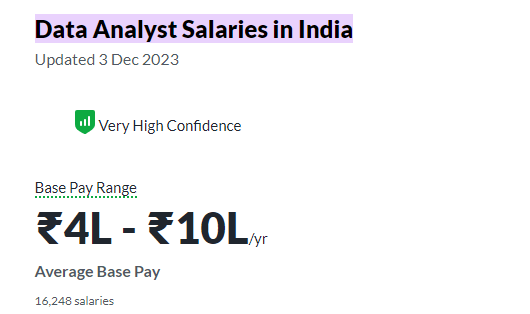
According to Glassdoor, the average salary of a data analyst in India is around 4 lakh to 10 lakh per annum, even as a fresher.
Average pay in India
In today’s world, there is a huge demand for data analysts as companies hire experts capable of managing their data proficiently.
Top product-based companies offering positions for data analysts include Amazon, Microsoft, Capital One, Walmart, PayPal, Google, Facebook, Twitter, Bloomberg, and Apple, among others.
How Can Kochiva Help You?
Our Data Analyst course is a wonderful place to start. The course will cover Fundamentals to Data Analytics, Business Analytics using Excel, Tableau training, and Power BI. Additionally, you will study Python and R programming basics as well as data analytics.
And at the end of your course, you will work on your project. With our assistance, you will become a DA.
Conclusion
Becoming a data analyst means combining learning, skill-building, and hands-on experience while keeping up with changes in data analysis. Start with a solid statistics or computer science education by completing a bachelor’s degree. After that, focus on learning programming languages like Python or R. Improve your skills in tools for visualizing data, and understanding statistics.

If you are wondering how to become a data analyst, you must possess certain data analysis abilities along with finishing a few tasks. In this article on how to become a data analyst, we will provide you with an in-depth overview of what you must do to become data analyst, the requirements for a data analyst, and get you one step closer to realizing your dream of being a data analyst.
A data analyst collects and analyzes lots of data. Whether a business is big or small, it creates and gathers a lot of different information like customer feedback, accounts, logistics, marketing research, Sales Reports, Profit and Loss reports, employee datasheet, expense reports, and more.
How to Become Data Analyst in Just 5 Steps
Becoming a data analyst involves different steps, including educational qualification, Skill Development, and practical Experience.
So, let’s explore how to become a data analyst in just 5 ways.
1.) Educational Background
Data analysis requires a bachelor’s degree in statistics, mathematics, computer science, information technology, and economics. This can help you have a better understanding of the field and make you a better fit for possible companies. There is dispute over whether certificates make a difference. Remember that putting them on will not have a negative impact on your resume.
2.) Develop Essential Data Analytics Skills
To get recruited as a data analyst, you must have solid technical skills. You must learn programming languages such as Python, R, or SQL to handle and analyze data. As data visualization is a part of the job of a data analyst, masterings tools like Tablaue, Power BI, and Excel can help you a lot. You should also have a basic knowledge of Machine Learning, hypothesis testing, regression, and probability distributions. To build these skills systematically, consider an online Python course that progresses from core syntax to pandas, data visualization (Matplotlib/Seaborn), and introductory machine learning.
3.) Gain practical experience
The most important part of becoming a data analyst is to gain practical experience and work on real-world projects. .To get practical experience, you can work on public datasets from GitHub, or Indian government open data portals.
Moreover, you can try solving real business problems such as analyzing customer behavior or predicting sales trends and participating in hackathons. To ensure effective implementation, consider exploring how Zoho consulting services can tailor solutions to specific business needs. Gaining skills in outbound sales solutions can further enhance your ability to analyze and interpret market data effectively. Additionally, gaining hands-on experience with sales engagement tools can help you understand how to nurture leads and improve conversion rates.
Try to grab internship opportunities that add an extra edge to your portfolio. These experiences provide valuable exposure and networking opportunities.
4.) Build a Strong Resume and Portfolio
Putting together a portfolio of your work is an excellent method to demonstrate your talents and experience to potential employers. Your portfolio should include samples of data analysis tasks you’ve completed, as well as any relevant qualifications or certifications. Include projects using SQL, Excel, Python, and a visualization tool like Power BI or Tableau.
Moreover, you can try uploading your projects on GitHub and writing blogs on LinkedIn showing your analysis. You can also use QR codes created via Scanova to link your resume or portfolio directly to your online projects, making it easy for employers to access your work instantly.
5.) Gain Certifications and Apply for Data analyst Jobs
Certifications can help you stand out, especially if you’re self-taught. Online platforms like Kochiva can help you stand out in a competitive job market of data analysts. With Kochiva you can learn all the essential skills required in the field of data analysis by sitting at your place.
The field of data analysis provides huge opportunities for business analysts, data analysts, sales analysts, data scientists, marketing analysts, data architects, and much more. In digital marketing, implementing white label SEO can help agencies provide comprehensive SEO services under their own branding without additional overhead. To further strengthen their offerings, agencies can also partner with a link building agency to deliver high-quality backlink strategies that enhance search visibility and long-term organic growth.
Why Start a Career as a Data Analyst?
The demand for data analysts is at an all-time high. According to a report, there are 10 million job openings for data analysts by 2026. Almost all kinds of businesses are undergoing digital transformation, which is why they are generating huge amounts of data.
Starting career as a data analyst can be the best choice for these reasons –
1. High Demand for Data Analysts Across Industries
According to the U.S. Bureau of Labor Statistics, data-related jobs are projected to grow by 35% from 2022 to 2032, much faster than the average for all occupations.
2. Competitive Salaries, Even for Entry-Level Roles
As per reports, the average base salary for a data analyst in the U.S. is $74,000 per year, with experienced professionals earning well over $100,000 annually in roles like Senior Data Analyst or Analytics Manager.
3. Future-Proof Career with Growth Opportunities
By 2025, around 97 million new roles may emerge that are more adapted to the division of labor between humans and machines—with data analytics being a key area of growth.
How Long Does it Take to Become a Data Analyst
How long it takes to learn data analysis can be different for everyone. It depends on things like what you already know, how much you want to understand, and the learning materials you use.
If You’re Starting from Scratch (No Tech or Math Background)
If You Have a Related Background (e.g., Business, IT, Math)
How to Become a Data Analyst Without a Degree
Develop Essential Technical Skills
Take Online Courses & Earn Certifications
Online platforms offer great resources to help you build expertise:
Build a Portfolio with Real-World Projects
Work with open datasets to create your own analysis projects. Showcase your skills by:
Gain Hands-On Experience
Apply what you’ve learned through internships, freelancing, or volunteer projects. Even small experiences can make a big difference when applying for your first job.
Network and Start Applying
Get active in the data community:
Data Analyst Salary
According to Glassdoor, the average salary of a data analyst in India is around 4 lakh to 10 lakh per annum, even as a fresher.
Average pay in India
In today’s world, there is a huge demand for data analysts as companies hire experts capable of managing their data proficiently.
Top product-based companies offering positions for data analysts include Amazon, Microsoft, Capital One, Walmart, PayPal, Google, Facebook, Twitter, Bloomberg, and Apple, among others.
How Can Kochiva Help You?
Our Data Analyst course is a wonderful place to start. The course will cover Fundamentals to Data Analytics, Business Analytics using Excel, Tableau training, and Power BI. Additionally, you will study Python and R programming basics as well as data analytics.
And at the end of your course, you will work on your project. With our assistance, you will become a DA.
Conclusion
Becoming a data analyst means combining learning, skill-building, and hands-on experience while keeping up with changes in data analysis. Start with a solid statistics or computer science education by completing a bachelor’s degree. After that, focus on learning programming languages like Python or R. Improve your skills in tools for visualizing data, and understanding statistics.
Best Online Spanish Classes in India
Best Online German Classes in India
Best Online French Classes in India (2026)
Top 6 Tef Preparation Course in India- Find the Best Listings Here
Top 5 TEF Preparation Course in Montreal 2026 Guide
How much time it takes to learn French CLB 7 (NCLC 7)?
Request a Call Back
Related Posts
Top 6 Tef Preparation Course in India- Find the Best Listings Here
Read MoreFinding the top TEF preparation course in India can make your French learning journey more structured and driven. Whether you are preparing for TEF Canada for higher education, immigration, or professional reasons, the right course can help you improve your listening, writing, reading, and speaking skills while becoming familiar with the exam format. With many […]
Top 5 TEF Preparation Course in Montreal 2026 Guide
Read MoreThe TEF Preparation course in Montreal can help you prepare for the exam with structured lessons, practice sessions, and expert guidance. There are several learning options available; you can choose the right course for yourself depending on factors such as target score, budget, course duration, and preferred learning format. Learning French in Montreal can help […]
How much time it takes to learn French CLB 7 (NCLC 7)?
Read MoreHow much time it takes to learn French CLB 7 (NCLC 7) depends on various factors, such as your current French level and how much effort you put in every day. It can take from several months to years depending on your current level, how much time you study, and how many efforts you put […]
How Much Time It Takes to Learn French CLB 5? Realistic Timeline
Read MoreHow much time it takes to learn French CLB 5 (NCLC 5) depends on your current French level, how often you study, and consistency. A beginner may need around 6 to 12 months of regular study to reach CLB 5 (meaning roughly 350 to 450 hours of study), while learners who have some basic French […]
How long does it take to prepare for TEF Canada?
Read MoreHow long does it take to prepare for TEF Canada? Preparing for TEF Canada can take anywhere from 3 to 12 months to over a year, depending on your current French level, target score, and how consistently you study. A beginner may need significantly more time to build the language skills required for the exam, while learners […]
Meet Our Conversion Expert